有机化学 ›› 2026, Vol. 46 ›› Issue (9): 3578-3586.DOI: 10.6023/cjoc202604023 上一篇 下一篇
研究论文
赫景瑞, 王蕴歆, 梅海波*( ), 韩建林*()
收稿日期:2026-04-15
修回日期:2026-05-19
发布日期:2026-07-06
基金资助:
Jingrui He, Yunxin Wang, Haibo Mei*(), Jianlin Han*()
Received:2026-04-15
Revised:2026-05-19
Published:2026-07-06
Contact:
About author:Dedicated to the 100th anniversary of the birth of Professor Xikui Jiang.
Supported by:文章分享
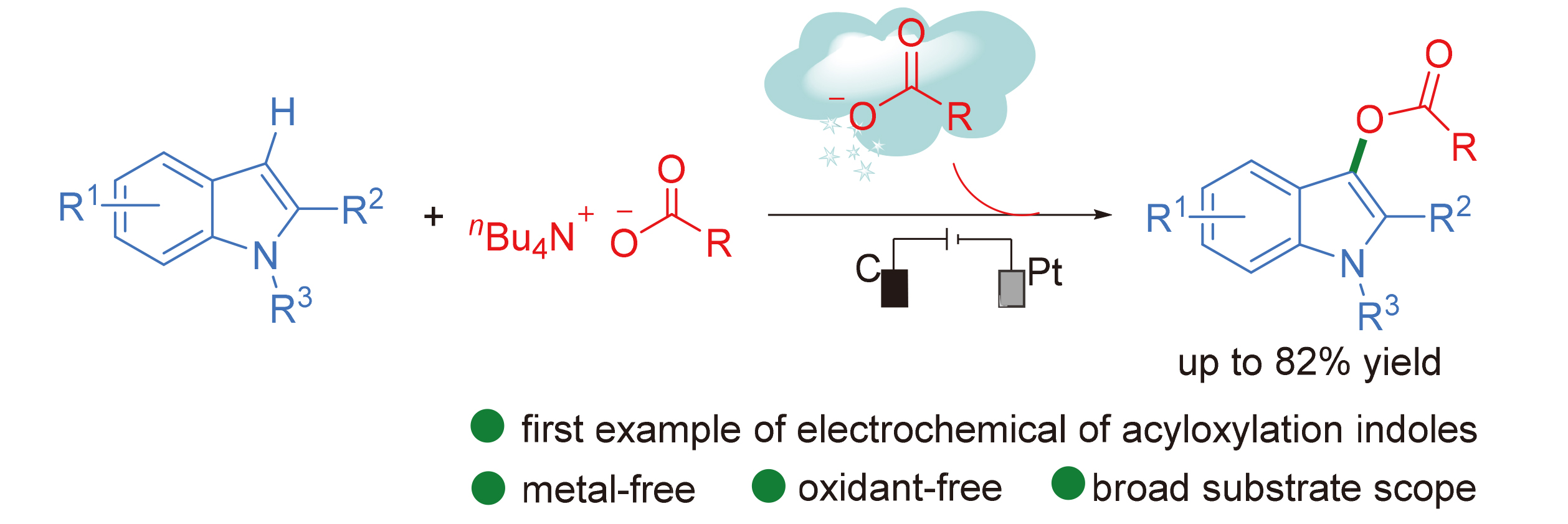
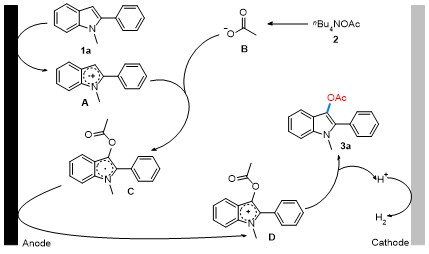
电化学条件下吲哚的官能团化反应是构建吲哚衍生物的一种高效绿色的方法. 本工作首次报道了一种新型的电化学条件下2-芳基吲哚C3位酰氧基化反应. 该反应使用四丁基羧酸铵盐作为酰氧基源和电解质, 在无催化剂和氧化剂的条件下, 以中等至优异的产率生成了酰氧基化的吲哚产物. 根据机理研究结果, 提出反应是通过吲哚阳极氧化形成自由基阳离子, 然后与羧酸负离子直接偶联的步骤进行. 该反应条件温和, 反应底物适用性广, 为合成3-酰氧基吲哚提供了一种新型的绿色的策略.
赫景瑞, 王蕴歆, 梅海波, 韩建林. 电化学条件下以羧酸铵为酰氧基源的吲哚直接酰氧基化反应[J]. 有机化学, 2026, 46(9): 3578-3586.
Jingrui He, Yunxin Wang, Haibo Mei, Jianlin Han. Electrochemical Direct Acyloxylation of Indoles with Ammonium Carboxylates as Acyloxyl Sources[J]. Chinese Journal of Organic Chemistry, 2026, 46(9): 3578-3586.
| Entry | 2/equiv. | Electrode | Solvent | Time/h | Temperature/℃ | Current/mA | Yieldb/% |
|---|---|---|---|---|---|---|---|
| 1 | 1.5 | Pt/Pt | MeCN | 5 | 60 | 5 | 22 |
| 2 | 1.5 | Pt/Ni | MeCN | 5 | 60 | 5 | 26 |
| 3 | 1.5 | C/C | MeCN | 5 | 60 | 5 | 26 |
| 4 | 1.5 | C/Ni | MeCN | 5 | 60 | 5 | 52 |
| 5 | 1.5 | C/Pt | MeCN | 5 | 60 | 5 | 65 |
| 6 | 1.5 | C/SS | MeCN | 5 | 60 | 5 | 55 |
| 7 | 1.5 | C/Zn | MeCN | 5 | 60 | 5 | 64 |
| 8 | 1.5 | C/Pt | MeCN | 5 | 60 | 5 | 37 c |
| 9 | 1.2 | C/Pt | MeCN | 5 | 60 | 5 | 51 |
| 10 | 2 | C/Pt | MeCN | 5 | 60 | 5 | 58 |
| 11 | 3 | C/Pt | MeCN | 5 | 60 | 5 | 63 |
| 12 | 1.5 | C/Pt | MeCN | 5 | 80 | 5 | 55 |
| 13 | 1.5 | C/Pt | MeCN | 5 | r.t. | 5 | 54 |
| 14 | 1.5 | C/Pt | 1,4-dioxane | 5 | 60 | 5 | Trace |
| 15 | 1.5 | C/Pt | DMF | 5 | 60 | 5 | 71 |
| 16 | 1.5 | C/Pt | EtOH | 5 | 60 | 5 | Trace |
| 17 | 1.5 | C/Pt | DCE | 5 | 60 | 5 | Trace |
| 18 | 1.5 | C/Pt | DMSO | 5 | 60 | 5 | 70 |
| 19 | 1.5 | C/Pt | DMA | 5 | 60 | 5 | 58 |
| 20 | 1.5 | C/Pt | DMF | 7 | 60 | 3 | 80 |
| 21 | 1.5 | C/Pt | DMF | 3 | 60 | 10 | 56 |
| Entry | 2/equiv. | Electrode | Solvent | Time/h | Temperature/℃ | Current/mA | Yieldb/% |
|---|---|---|---|---|---|---|---|
| 1 | 1.5 | Pt/Pt | MeCN | 5 | 60 | 5 | 22 |
| 2 | 1.5 | Pt/Ni | MeCN | 5 | 60 | 5 | 26 |
| 3 | 1.5 | C/C | MeCN | 5 | 60 | 5 | 26 |
| 4 | 1.5 | C/Ni | MeCN | 5 | 60 | 5 | 52 |
| 5 | 1.5 | C/Pt | MeCN | 5 | 60 | 5 | 65 |
| 6 | 1.5 | C/SS | MeCN | 5 | 60 | 5 | 55 |
| 7 | 1.5 | C/Zn | MeCN | 5 | 60 | 5 | 64 |
| 8 | 1.5 | C/Pt | MeCN | 5 | 60 | 5 | 37 c |
| 9 | 1.2 | C/Pt | MeCN | 5 | 60 | 5 | 51 |
| 10 | 2 | C/Pt | MeCN | 5 | 60 | 5 | 58 |
| 11 | 3 | C/Pt | MeCN | 5 | 60 | 5 | 63 |
| 12 | 1.5 | C/Pt | MeCN | 5 | 80 | 5 | 55 |
| 13 | 1.5 | C/Pt | MeCN | 5 | r.t. | 5 | 54 |
| 14 | 1.5 | C/Pt | 1,4-dioxane | 5 | 60 | 5 | Trace |
| 15 | 1.5 | C/Pt | DMF | 5 | 60 | 5 | 71 |
| 16 | 1.5 | C/Pt | EtOH | 5 | 60 | 5 | Trace |
| 17 | 1.5 | C/Pt | DCE | 5 | 60 | 5 | Trace |
| 18 | 1.5 | C/Pt | DMSO | 5 | 60 | 5 | 70 |
| 19 | 1.5 | C/Pt | DMA | 5 | 60 | 5 | 58 |
| 20 | 1.5 | C/Pt | DMF | 7 | 60 | 3 | 80 |
| 21 | 1.5 | C/Pt | DMF | 3 | 60 | 10 | 56 |
| [1] |
(a)
doi: 10.1039/D3MD00560G pmid: 36790012 |
|
(b)
doi: 10.1039/d2np00085g pmid: 36790012 |
|
|
(c)
doi: 10.1016/j.cclet.2025.111048 pmid: 36790012 |
|
| [2] |
(a)
doi: 10.1016/j.ejmech.2014.10.065 |
|
(b)
doi: 10.1039/D3MD00677H |
|
|
(c)
doi: 10.1021/acs.jafc.5c04293 |
|
|
(d)
doi: 10.1016/j.cclet.2023.109005 |
|
| [3] |
(a)
|
|
(b)
doi: 10.1016/j.cclet.2023.108902 |
|
|
(c)
|
|
|
(d)
doi: 10.1016/j.cclet.2026.112405 |
|
|
(e)
doi: 10.6023/cjoc202506013 |
|
|
(冯发秀, 徐世杰, 王雪, 杨卓然, 王文君, 黄申林, 张小祥, 有机化学, 2026, 46, 225.)
|
|
|
(f)
|
|
|
(g)
doi: 10.1021/cr2003954 |
|
| [4] |
(a)
doi: 10.1021/acs.jmedchem.7b00825 pmid: 20099862 |
|
(b)
doi: 10.1055/s-1999-3490 pmid: 20099862 |
|
|
(c)
doi: 10.1021/jo902406b pmid: 20099862 |
|
|
(d)
doi: 10.1039/C6RA27478A pmid: 20099862 |
|
| [5] |
(a)
doi: 10.1021/jo01083a610 |
|
(b)
doi: 10.1039/b802054j |
|
| [6] |
doi: 10.1039/D5SC00449G |
| [7] |
doi: 10.1002/ajoc.v7.2 |
| [8] |
doi: 10.1039/D3CC05799B |
| [9] |
doi: 10.1039/C5RA10428A |
| [10] |
doi: 10.1021/acs.orglett.3c03568 |
| [11] |
doi: 10.1002/adsc.v360.8 |
| [12] |
(a)
doi: 10.1002/chem.v17.8 pmid: 19689144 |
|
(b)
doi: 10.1021/ol201665c pmid: 19689144 |
|
|
(c)
doi: 10.1021/jo901321b pmid: 19689144 |
|
|
(d)
doi: 10.1021/jo101584k pmid: 19689144 |
|
| [13] |
doi: 10.1021/jo902265s |
| [14] |
doi: 10.1039/D3CC01683H |
| [15] |
(a)
doi: 10.1039/D4OB01703J |
|
(b)
doi: 10.1039/D5CC01342A |
|
|
(c)
|
|
|
(d)
doi: 10.1016/j.tet.2025.134632 |
|
|
(e)
doi: 10.1002/cjoc.v43.24 |
|
| [16] |
doi: 10.1021/acs.joc.3c00267 |
| [17] |
|
| [1] | 曾添晴, 倪宇阳, 袁瑶, 朱钢国. 可见光诱导叔胺促进的烯烃酰基氟烷基化反应[J]. 有机化学, 2026, 46(9): 3737-3747. |
| [2] | 吴志杰, 周超, 李金山, 徐佳欣, 张义成, 刘杰, 王磊. 可见光促进通过氢原子转移合成1,4-二羰基衍生物[J]. 有机化学, 2026, 46(8): 3158-3168. |
| [3] | 韩银松, 王东炜, 肖佳怡, 冯若昆. 酰胺噁唑啉导向的铜催化[2.2]对环芳烷直接C—H酰氧基化反应[J]. 有机化学, 2026, 46(8): 3147-3157. |
| [4] | 吉伟文, 叶宁, 金健. 配体辅助电荷转移驱动的光促铁催化[J]. 有机化学, 2026, 46(7): 2683-2700. |
| [5] | 王齐翔, 陈圣希, 王静, 陈栋, 鲍晓光, 吴新鑫. 无金属参与的多烯选择性氯代反应[J]. 有机化学, 2026, 46(4): 1750-1762. |
| [6] | 郑婧斐, 吕琪妍, 孙凯, 陈晓岚, 屈凌波, 王金泉, 於兵. 自由基介导的6-氮杂尿嘧啶官能团化研究进展[J]. 有机化学, 2026, 46(4): 1603-1620. |
| [7] | 刘世峥, 窦明煜, 崔玉, 窦建民, 魏文廷. 自由基硒磺酰化研究进展[J]. 有机化学, 2026, 46(4): 1621-1634. |
| [8] | 赵雨晴, 朱先进, 石凌宇, 魏鸣宇, 徐紫涵, 石永佳, 李旭锋, 杨道山. 环硫鎓盐开环官能化反应的研究进展[J]. 有机化学, 2026, 46(4): 1572-1602. |
| [9] | 杨珊, 陈亚苏, 朱晨. 自由基介导的官能团迁移-环化构建含氮稠杂芳烃[J]. 有机化学, 2026, 46(4): 1739-1749. |
| [10] | 吉伟文, 金健. 配体-金属电荷转移驱动的光促金属催化芳基羧酸脱羧转化[J]. 有机化学, 2026, 46(4): 1320-1329. |
| [11] | 刘勇, 李娟, 王凌凡, 黄宝彤, 彭凌子, 宋琎, 郭昌. 电化学驱动1,3-二羰基化合物与烯烃的自由基烷基化反应[J]. 有机化学, 2026, 46(4): 1659-1667. |
| [12] | 张斌, 肖文精, 陈加荣. 烯烃自由基阴离子的可控产生与转化[J]. 有机化学, 2026, 46(4): 1181-1204. |
| [13] | 刘颖杰, 闵来生, 杨锐蓉, 宋冬雪, 彭瑞, 梁德强. CuI催化C—C键偶联反应构建2-羰基-1,4-二酮[J]. 有机化学, 2026, 46(2): 603-611. |
| [14] | 谭永波, 舒洪波, 黄华文. 光诱导N-芳基丙烯酰胺参与的吲哚酮合成研究进展[J]. 有机化学, 2025, 45(6): 2086-2108. |
| [15] | 李顺曦, 游力栩, 李玉龙, 舒伟. 光介导氨及其等价体参与的碳氮成键反应研究进展[J]. 有机化学, 2025, 45(5): 1460-1477. |
| 阅读次数 | ||||||
|
全文 |
|
|||||
|
摘要 |
|
|||||