有机化学 ›› 2026, Vol. 46 ›› Issue (9): 3615-3623.DOI: 10.6023/cjoc202606022 上一篇 下一篇
研究论文
任慧敏a,b, 茆勇军a,*( ), 王子超b,*(), 施世良b,c,*()
收稿日期:2026-06-18
修回日期:2026-07-20
发布日期:2026-08-03
基金资助:
Huimin Rena,b, Yongjun Maoa,*(), Zichao Wangb,*(), Shiliang Shib,c,*()
Received:2026-06-18
Revised:2026-07-20
Published:2026-08-03
Contact:
About author:Dedicated to the 100th anniversary of the birth of Professor Xikui Jiang.
Supported by:文章分享

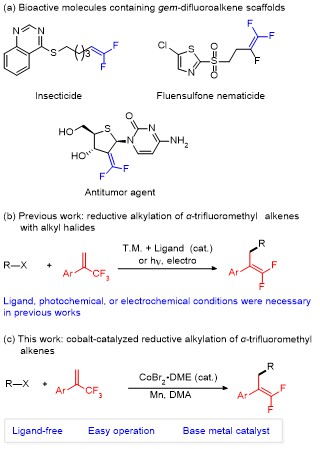
偕二氟烯烃是一类重要的化合物, α-三氟甲基烯烃的还原烷基化反应为这类化合物的合成提供了一种直接高效的合成方法. 利用廉价金属钴作为金属催化剂, 无需额外配体即可实现α-三氟甲基烯烃的还原烷基化反应, 以良好的效率合成系列偕二氟烯烃化合物. 该反应体系具有实用高效的特点.
任慧敏, 茆勇军, 王子超, 施世良. 钴催化α-三氟甲基烯烃的脱氟还原偶联反应制备偕二氟烯烃[J]. 有机化学, 2026, 46(9): 3615-3623.
Huimin Ren, Yongjun Mao, Zichao Wang, Shiliang Shi. Synthesis of gem-Difluoroalkenes via Cobalt-Catalyzed Defluorinative Reductive Coupling of α‑Trifluoromethyl Alkenes[J]. Chinese Journal of Organic Chemistry, 2026, 46(9): 3615-3623.
| [1] |
(a)
doi: 10.1021/jm1013693 pmid: 3039140 |
|
(b)
doi: 10.1021/acs.chemrev.4c00661 pmid: 3039140 |
|
|
(c)
pmid: 3039140 |
|
| [2] |
(a)
doi: 10.1002/anie.v58.2 |
|
(b)
doi: 10.1021/jacs.7b00118 |
|
|
(c)
doi: 10.1002/anie.v58.14 |
|
|
(d)
doi: 10.1039/D0CC04318D |
|
|
(e)
doi: 10.1021/jacs.7b06469 |
|
|
(f)
doi: 10.31635/ccschem.024.202403958 |
|
| [3] |
(a)
doi: 10.1016/j.jfluchem.2005.12.013 |
|
(b)
doi: 10.1021/jm034162s |
|
|
(c)
doi: 10.1021/ja021487+ |
|
| [4] |
(a)
doi: 10.1021/cr200165q pmid: 22085400 |
|
(b)
doi: 10.1039/D1CC06446K pmid: 22085400 |
|
|
(c)
pmid: 22085400 |
|
| [5] |
(a)
doi: 10.1039/D5QO01732G pmid: 35865891 |
|
(b)
doi: 10.1002/adsc.v364.2 pmid: 35865891 |
|
|
(c)
pmid: 35865891 |
|
|
(d)
pmid: 35865891 |
|
|
(e)
doi: 10.1002/anie.v56.47 pmid: 35865891 |
|
|
(f)
pmid: 35865891 |
|
|
(g)
doi: 10.1039/d2sc02732a pmid: 35865891 |
|
|
(h)
doi: 10.1021/acs.orglett.2c00979 pmid: 35865891 |
|
|
(i)
doi: 10.1021/acs.orglett.1c01385 pmid: 35865891 |
|
|
(j)
doi: 10.1021/jacs.1c04531 pmid: 35865891 |
|
|
(k)
doi: 10.1021/acs.orglett.0c00960 pmid: 35865891 |
|
|
(l)
doi: 10.1021/jacs.1c03126 pmid: 35865891 |
|
|
(m)
doi: 10.1039/C8SC04335C pmid: 35865891 |
|
| [6] |
(a)
doi: 10.1021/acscatal.8b02784 |
|
(b)
doi: 10.1021/acs.orglett.9b03102 |
|
| [7] |
doi: 10.1038/s41467-020-18658-4 |
| [8] |
doi: 10.1021/acs.orglett.2c00800 |
| [9] |
(a)
doi: 10.1039/D2CC06022A |
|
(b)
doi: 10.1002/adsc.v365.8 |
|
|
(c)
doi: 10.6023/cjoc202505016 |
|
|
(许文, 罗美明, 曾小明, 有机化学, 2025, 45, 3401.)
doi: 10.6023/cjoc202505016 |
|
|
(d)
doi: 10.6023/cjoc202603041 |
|
|
(房毅, 王川, 有机化学, 2026, 46, 2743.)
doi: 10.6023/cjoc202603041 |
|
| [10] |
(a)
doi: 10.1007/s11426-021-1210-y |
|
(b)
doi: 10.1039/D1QO01460A |
|
|
(c)
doi: 10.6023/cjoc202108006 |
|
|
(常哲, 王佳鑫, 陆熹, 傅尧, 有机化学, 2022, 42, 147.)
|
|
|
(d)
doi: 10.1038/s41467-021-27060-7 |
|
| [11] |
(a)
doi: 10.1039/D2GC02266D |
|
(b)
doi: 10.1039/D1CC04284J |
|
|
(c)
|
|
|
(d)
doi: 10.1021/acs.orglett.1c03917 |
|
| [12] |
(a)
doi: 10.1021/acs.accounts.5c00304 |
|
(b)
doi: 10.6023/cjoc202401027 |
|
|
(刘晓东, 施世良, 有机化学, 2024, 44, 1884.)
doi: 10.6023/cjoc202401027 |
|
|
(c)
|
|
|
(d)
doi: 10.1016/j.scib.2024.12.023 |
|
| [1] | 刘德洋, 周涛, 史炳锋. 钴催化环氧化物羰基化反应合成β-羟基酯[J]. 有机化学, 2026, 46(9): 3748-3758. |
| [2] | 王彬, 叶波, 王磊, 何红, 马永敏. 光诱导下三氟甲基烯烃C—F键断裂合成偕二氟烯烃[J]. 有机化学, 2026, 46(8): 3219-3226. |
| [3] | 任汝通, 卢诗超, 李洪爽. 丰产金属钴催化的烯烃氢酰化反应[J]. 有机化学, 2026, 46(7): 2701-2712. |
| [4] | 肖潜, 钟建基. 钴催化碳-硫键构建研究进展[J]. 有机化学, 2026, 46(7): 2644-2668. |
| [5] | 房毅, 王川. 镍催化三氟甲基取代烯烃与烷基甲磺酸酯的烯丙位脱氟交叉亲电偶联[J]. 有机化学, 2026, 46(7): 2743-2750. |
| [6] | 陈丽萍, 马瑞, 池建军, 金彧帆, 王清, 汪洋, 朱雪华, 庞玉博. 钴催化1-三甲硅基-2-芳基乙炔的α位芳基化反应[J]. 有机化学, 2026, 46(7): 2760-2769. |
| [7] | 范润东, 陈冰然, 黎富奇, 陈锦秀, 严琼姣, 汪伟, 周慧. 无光敏剂光诱导α-三氟甲基烯烃的氢二氟烷基化反应[J]. 有机化学, 2026, 46(2): 641-652. |
| [8] | 许文, 罗美明, 曾小明. 铬催化三氟甲基烯烃的还原交叉偶联[J]. 有机化学, 2025, 45(9): 3401-3411. |
| [9] | 李旻昊, 王泽溟, 黄庆, 左伟伟. 钴(II)催化的酮不对称转移氢化反应[J]. 有机化学, 2025, 45(7): 2451-2460. |
| [10] | 田勋, 邓国刚, 羊晓东. 钴催化C(sp2)—H活化构建苯并含氮杂环骨架的研究进展[J]. 有机化学, 2025, 45(2): 655-667. |
| [11] | 刘占祥, 洪超, 李思源, 黄圣儒, 张柠霞, 冯若昆, 张玉红. 钴催化α,β-不饱和酮肟酯自偶联环化反应合成2,4,6-三取代吡啶[J]. 有机化学, 2025, 45(10): 3777-3785. |
| [12] | 慕晓楠, 管敏慧, 牛雨龙, 陈浩, 李传莹, 王磊. 光诱导重氮酸酯与偕二氟烯烃[1+2]环加成合成二氟环丙烷[J]. 有机化学, 2025, 45(1): 256-266. |
| [13] | 杜佳言, 刘俊涛, 刘桂霞, 黄正. 钴催化末端烯烃区域和立体选择性异构合成反式-2-烯烃[J]. 有机化学, 2024, 44(9): 2889-2897. |
| [14] | 孙超, 周泉, 李传莹, 王磊. 苯并唑-氮杂环卡宾钯配合物的合成表征及应用[J]. 有机化学, 2024, 44(6): 1957-1966. |
| [15] | 曹香雪, 贾雅会, 殷世纪, 徐亮, 韦玉, 宋欢欢. 可见光诱导二氢喹唑啉酮碳碳键断裂与三氟甲基取代烯烃的脱氟烷基化反应研究[J]. 有机化学, 2024, 44(5): 1549-1557. |
| 阅读次数 | ||||||
|
全文 |
|
|||||
|
摘要 |
|
|||||