有机化学 ›› 2026, Vol. 46 ›› Issue (4): 1181-1204.DOI: 10.6023/cjoc202603031 上一篇 下一篇
综述与进展
张斌, 肖文精, 陈加荣*( )
)
收稿日期:2026-03-22
修回日期:2026-03-31
发布日期:2026-04-13
通讯作者:
陈加荣
基金资助:
Bin Zhang, Wenjing Xiao, Jiarong Chen*()
Received:2026-03-22
Revised:2026-03-31
Published:2026-04-13
Contact:
Jiarong Chen
Supported by:文章分享
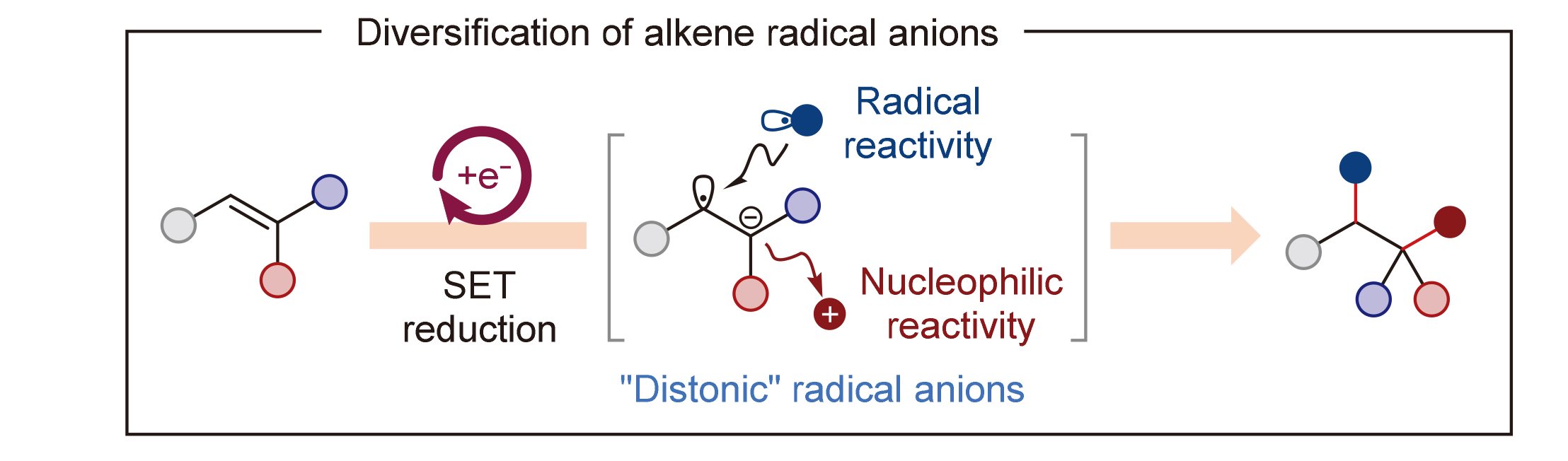
烯烃自由基阴离子作为一类兼具自由基与碳负离子双重反应特性的高活性中间体, 在有机合成领域展现出独特的应用价值. 然而, 由于缺少温和可控的产生方法, 导致其参与的反应类型受限、底物适用范围较窄, 且反应立体选择性难以调控等问题. 因此, 烯烃自由基阴离子的可控生成与高选择性转化面临着多重挑战. 近年来, 随着新型催化体系的持续开发与不断发展, 烯烃自由基阴离子的反应类型已得到初步拓展, 为相关领域的合成研究提供了更多可能性. 本文将从烯烃自由基阴离子的不同生成方式及其参与的多样化转化反应两个维度出发, 简要综述该类中间体的三类主要生成策略——化学还原、电化学还原和光化学还原, 及其在几类重要烯烃转化反应中的研究进展, 并对该领域未来的发展方向进行展望.
张斌, 肖文精, 陈加荣. 烯烃自由基阴离子的可控产生与转化[J]. 有机化学, 2026, 46(4): 1181-1204.
Bin Zhang, Wenjing Xiao, Jiarong Chen. Controlled Generation and Transformations of Alkene Radical Anions[J]. Chinese Journal of Organic Chemistry, 2026, 46(4): 1181-1204.
| [60] |
|
| [61] |
|
| [62] |
|
| [63] |
|
| [64] |
|
| [65] |
|
| [1] |
|
| [2] |
|
| [3] |
|
| [4] |
|
| [5] |
|
| [6] |
|
| [7] |
|
| [8] |
|
| [66] |
|
| [67] |
|
| [68] |
|
| [69] |
|
| [70] |
|
| [71] |
|
| [9] |
|
| [10] |
|
| [11] |
|
| [12] |
|
| [13] |
|
| [14] |
|
| [15] |
|
| [16] |
|
| [72] |
|
| [73] |
|
| [74] |
|
| [75] |
|
| [76] |
|
| [77] |
|
| [78] |
|
| [17] |
|
| [18] |
|
| [19] |
|
| [20] |
|
| [21] |
|
| [22] |
|
| [23] |
|
| [24] |
|
| [79] |
|
| [80] |
|
| [81] |
|
| [82] |
|
| [83] |
|
| [84] |
|
| [85] |
|
| [86] |
|
| [87] |
|
| [88] |
|
| [89] |
|
| [25] |
|
| [26] |
|
| [27] |
|
| [28] |
|
| [29] |
|
| [30] |
|
| [90] |
|
| [91] |
|
| [92] |
|
| [93] |
|
| [94] |
|
| [95] |
|
| [96] |
|
| [31] |
|
| [32] |
|
| [33] |
|
| [34] |
|
| [35] |
|
| [36] |
|
| [97] |
|
| [98] |
|
| [99] |
|
| [100] |
|
| [37] |
|
| [38] |
|
| [39] |
|
| [40] |
|
| [41] |
|
| [42] |
|
| [43] |
|
| [44] |
|
| [45] |
|
| [46] |
|
| [47] |
|
| [48] |
|
| [49] |
|
| [50] |
|
| [51] |
|
| [52] |
|
| [53] |
|
| [54] |
|
| [55] |
|
| [56] |
|
| [57] |
|
| [58] |
|
| [59] |
|
| [1] | 王齐翔, 陈圣希, 王静, 陈栋, 鲍晓光, 吴新鑫. 无金属参与的多烯选择性氯代反应[J]. 有机化学, 2026, 46(4): 1750-1762. |
| [2] | 郑婧斐, 吕琪妍, 孙凯, 陈晓岚, 屈凌波, 王金泉, 於兵. 自由基介导的6-氮杂尿嘧啶官能团化研究进展[J]. 有机化学, 2026, 46(4): 1603-1620. |
| [3] | 刘世峥, 窦明煜, 崔玉, 窦建民, 魏文廷. 自由基硒磺酰化研究进展[J]. 有机化学, 2026, 46(4): 1621-1634. |
| [4] | 赵雨晴, 朱先进, 石凌宇, 魏鸣宇, 徐紫涵, 石永佳, 李旭锋, 杨道山. 环硫鎓盐开环官能化反应的研究进展[J]. 有机化学, 2026, 46(4): 1572-1602. |
| [5] | 张皓然, 贾均松, 俞琼, 吴宇, 李玉龙, 舒伟. 可见光催化烯烃的氢胺化和氢(磺)酰胺化反应[J]. 有机化学, 2026, 46(4): 1166-1180. |
| [6] | 杨珊, 陈亚苏, 朱晨. 自由基介导的官能团迁移-环化构建含氮稠杂芳烃[J]. 有机化学, 2026, 46(4): 1739-1749. |
| [7] | 孟令旭, 申霖, 罗祥玲, 林玉妹, 龚磊. 具有光活性的铬、钴配合物的设计及其在有机合成中的应用进展[J]. 有机化学, 2026, 46(4): 1513-1528. |
| [8] | 吉伟文, 金健. 配体-金属电荷转移驱动的光促金属催化芳基羧酸脱羧转化[J]. 有机化学, 2026, 46(4): 1320-1329. |
| [9] | 刘勇, 李娟, 王凌凡, 黄宝彤, 彭凌子, 宋琎, 郭昌. 电化学驱动1,3-二羰基化合物与烯烃的自由基烷基化反应[J]. 有机化学, 2026, 46(4): 1659-1667. |
| [10] | 刘颖杰, 闵来生, 杨锐蓉, 宋冬雪, 彭瑞, 梁德强. CuI催化C—C键偶联反应构建2-羰基-1,4-二酮[J]. 有机化学, 2026, 46(2): 603-611. |
| [11] | 谭永波, 舒洪波, 黄华文. 光诱导N-芳基丙烯酰胺参与的吲哚酮合成研究进展[J]. 有机化学, 2025, 45(6): 2086-2108. |
| [12] | 李顺曦, 游力栩, 李玉龙, 舒伟. 光介导氨及其等价体参与的碳氮成键反应研究进展[J]. 有机化学, 2025, 45(5): 1460-1477. |
| [13] | 吴昊岩, 赫明月, 马军安, 张发光. 三芳胺在光催化反应中的研究进展[J]. 有机化学, 2025, 45(5): 1634-1643. |
| [14] | 林风, 张艳, 吴明, 刘会艳, 郝文娟, 姜波. 利用可见光引发1,6-烯炔的增环酰化双官能化制备1-茚酮衍生物[J]. 有机化学, 2025, 45(5): 1729-1738. |
| [15] | 洪洋, 邓红平. 可见光催化的酸性C(sp3)—H键官能团化反应研究进展[J]. 有机化学, 2025, 45(5): 1569-1590. |
| 阅读次数 | ||||||
|
全文 |
|
|||||
|
摘要 |
|
|||||


